Since I'm not much of a photographer, let alone a videographer, it's been tough to share with you the sights and sounds of life in Kapoeta. Today, I turned up this short video from Voice of America that at least starts to capture some of the more festive scenes from our town. The first 30 seconds and the last 15 seconds or so were filmed here during the power plant inauguration. The rest (wherever you see green trees!) is not here--some of it is Juba and the rest is mostly filmed along the main highway running from Uganda to Juba.
In the video, keep an eye out for:
1) in the openning dance scene, the ladies to the right (not dancing) with leaf-green outfits are wearing goat skins covered with beads.
2) a white guy in a tan hat in the scene in the power station; Francis' 2 seconds of web-video fame
3) the ostrich feathers and leopard skins on the heads and backs, respectively, of the Toposa male dancers at the end -- I totally forgot to mention that before. I can't believe that big cats once roamed Toposaland!
In other news, I'm keeping busy doing some consulting jobs for my last two employers while I wait on an answer from the state about starting the town survey/mapping project. This last week has seen us post new record highs and lows on the weather station: daytime high of 107.6 and nighttime low of 63. I love the cold and the fact that it made us put a blanket on the bed for the first time EVER in Sudan! Our friends have graciously arranged for getting us cereal, cheese, and chocolate--the essentials which are, sadly, unavailable in Kapoeta. Our last grocery shopping trip was in early December and we won't be back in the land of supermarkets until late March--yikes!
Alright, I think that's it for now. Back to the grind I go...
Thursday, February 17, 2011

Monday, February 7, 2011
As Mother B likes to say, it's hotter than blazes...
Things continue to move along here. This past weekend was a milestone as the power plant was officially inaugurated (google "Kapoeta" and "electricity" for news reports--there's a bunch). We had the US Consul General (like the Ambassador for South Sudan--the #1 State Department guy in the country) and the governor here, along with about 2,000 community members. It went well--everyone seemed happy--but it was exhausting. I'm glad that everyone is gone, and Francis is happy to get back to the work of hooking up new customers.
On the eve of the inauguration, I was summoned to the house of the governor--more than a little intimidating! He asked me if I would be interested in doing a survey of the roads in town, and then creating a town plan so that plots can be demarkated and sold to people since right now no one really owns their land. I'm currently working on a proposal for him, and am thrilled about the opportunity to finally do something that puts my engineering skills to work in Sudan (well, at least for pay)! If it all works out, I know it will be long hours and will undoubtedly put me in the middle of some political quagmires, but it would be a great stepping stone for what I hope will be a change in careeer path following our time here.
The real reason that I sat down to write is to report on the weather. So, I have long written about it being hot and dry, but without proper instrumentation, I haven't been able to explain exactly how hot or dry. Our recent shipment of mail (this is the first mail drop since mid-October!) included a weather station. As I type, the outdoor sensor (placed in the shade) is reading 104.7 degrees F and 2% humidity. I didn't even know that 2% humidity was possible! Inside, we are at a rather balmy 92 degrees with 15% humidity. And the funny thing is, I'm so used to this now, that I'm not even sweating! While I'm sure that it would be extremely detrimental to my health to go directly from this to the frozen winter wonderland that you are all experiencing in the States, I do wish dearly for some snow...
So that is all for now. I'll keep my eye on the weather station and post if any records are broken. Hope you all stay warm...
On the eve of the inauguration, I was summoned to the house of the governor--more than a little intimidating! He asked me if I would be interested in doing a survey of the roads in town, and then creating a town plan so that plots can be demarkated and sold to people since right now no one really owns their land. I'm currently working on a proposal for him, and am thrilled about the opportunity to finally do something that puts my engineering skills to work in Sudan (well, at least for pay)! If it all works out, I know it will be long hours and will undoubtedly put me in the middle of some political quagmires, but it would be a great stepping stone for what I hope will be a change in careeer path following our time here.
The real reason that I sat down to write is to report on the weather. So, I have long written about it being hot and dry, but without proper instrumentation, I haven't been able to explain exactly how hot or dry. Our recent shipment of mail (this is the first mail drop since mid-October!) included a weather station. As I type, the outdoor sensor (placed in the shade) is reading 104.7 degrees F and 2% humidity. I didn't even know that 2% humidity was possible! Inside, we are at a rather balmy 92 degrees with 15% humidity. And the funny thing is, I'm so used to this now, that I'm not even sweating! While I'm sure that it would be extremely detrimental to my health to go directly from this to the frozen winter wonderland that you are all experiencing in the States, I do wish dearly for some snow...
So that is all for now. I'll keep my eye on the weather station and post if any records are broken. Hope you all stay warm...
Sunday, January 9, 2011
The Times, They are a Changin’
The last couple of weeks not only have seen the first days of a new decade. They have also brought with them lots of changes our lives here in Kapoeta.

Francis and I threw a New Years party, complete with party hats and horns, for the few foreigners who remained in Kapoeta through the holidays. We decided on a brunch, though, since we were otherwise occupied on New Years Eve, being the first night that the streetlights were turned on in Kapoeta. The county commissioner (head of the local government) switched on the diesel generator, threw the master switch, and then we drove around town in trucks to watch the streetlights come on as the sun set. The commissioner and Francis’ employees threw mini rallies under the lights, shouting out political slogans (“SPLM oye; Referendum oye”). After over a year of living here, it was great to finally see it up and operational, but now the hard part begins—building capacity to maintain the system and operate the utility.
The new year also saw a departure of Peter, the man who had served as my gardener and our nighttime guard since we arrived. When I hired him, Peter had told me that he wanted to go back to Kenya to get his highschool diploma (though Sudanese, nearly everyone with an education here studied in refugee camps in Kenya or Uganda during the war). I did what I could to keep him prepared; I required that he keep detailed records of his gardening activities, made him calculate areas when planting grass, set up a “chemistry lab” for soil testing, and passed on lots of books and magazines for him to read. …and sure enough, he kept to his word, leaving for school just before Christmas. His departure was both happy and sad: he left with some of the kindest words I have ever heard from the Sudanese, planted sunflowers in the garden so that I would think of him when I saw them, but he leaves behind big shoes to fill. I’m certain it was God who sent Peter here when we arrived last year, knowing that I wasn’t prepared to deal with staffing issues that plague nearly every organization here.
And finally, yesterday marked a new day for Southern Sudan. After 6 years of living under the Comprehensive Peace Agreement (CPA), southerners finally saw the day in which they could go to the polls to decide whether they will stay united with the North, or separate to form their own country. Voting will actually continue all of this week, and it will likely be a couple weeks before all of the ballots are counted, but this is a huge step. Though there were fears that there would be violence preventing a vote, at least in Kapoeta there has been peace (I haven’t been out of the compound today to learn if the same was true throughout the country).
So, those are the major things to report. I continue to look for a job here, Francis continues on with “bringing power to the people”, and together we deal with what life brings us. Among our most recent gifts: a broken washing machine (awaiting parts from the US), a broken AC unit (requiring total replacement from Kenya), but also a Catholic lectionary and song book in Toposa (from a very nice seminarian). We think often of our family and friends, and thank God that we are doing this together.
Sunday, December 12, 2010
Gorillas in the Mud

After a long hiatus, I’m back. Well, sorta. I’m still working on grad school applications, volunteering for Francis’ project, and trying to make this second Kapoeta Christmas nice (e.g. I’ve bought fabric to make a tablecloth for Christmas dinner). Needless to say, there might not be another post until January. But given the extraordinary nature of our recent adventures, I thought they warranted at least a pictorial posting.
Realizing that all work and no play makes for a dull life, we decided to take a bit of a holiday. Since visiting Rwanda in 2008, I’ve wanted to return. Though its notoriety is derived from the atrocities of the 1994 genocide, Rwanda is actually one of the most accessible, tourist-friendly spots in East Africa. It boasts comparatively excellent infrastructure, a hospitality industry geared towards English-speaking travelers, few (though I hesitate to say “no”) corrupt public servants, and laws that discourage begging/pan-handling. And, it is home to a good portion of the world’s remaining mountain gorillas and verdant, dramatic landscapes.

Thus, we decided to go for a long weekend to trek said gorillas and soak up scenic vistas along pothole-free roads. Rwanda did not disappoint (see pictures below). We opted for 2 days of gorilla trekking, and I’ve very glad for it, as the experiences were completely different. There are 8 habituated gorilla groups in Rwanda that tourists visit on a daily basis—a group of 8 humans (plus a guide and 2 trackers) are limited to an hour visit with them. But because these gorilla groups are on the move, it’s never quite certain how long or strenuous your hike to them will be. On the first day, we were assigned to the Umubano group and literally hiked straight up a volcanic mountain. Imagine that for 90 minutes straight you climb up a slippery extension latter, taking the rungs two at a time. Now, imagine that it’s not a ladder but rather some loose toeholds that the guide has dug into soft red soil with nothing but stinging nettle and loose vines to grab should you lose your balance. That was pretty much our journey. I thankfully had the assistance of a nice Rwandan porter named Simon who, despite his diminutive size, managed to pull me up the mountain. At the top, however, we were treated to amazing views of the valley below and to a mobile gorilla group. For an hour, we followed as they literally rolled down the mountain—the jungle was so thick that often times we (and the gorillas) weren’t standing/sitting on soil but atop 3 feet of trampled bushes. While I usually dread descents, the soft soil and thick foliage made it relatively easy to “fall” down the mountain without fear of bashing your head open on a rock.
 Baby reaching for bamboo
 Silverback
Nevertheless, after the tough climb, we requested an easier trek the next day, and boy did we get it! Assigned to the Kwitondo group, the most strenuous/technical component was breaching the 5 foot tall stone barrier separating the national park from farmland. Once inside the park, we spotted a silverback within 15 minutes. For the next hour, we moved through a maze of bamboo forest to catch the group as they snacked. Because it was feeding time, they tended to be spread out, but right before we left, the head silverback had assembled the group into what looked like a town meeting, providing an excellent glimpse of all of them at once (in panorama—I don’t think any camera could have gotten them all in since there were 20 of them and we were so close).
Oh, a note on proximity: the rules are that you are supposed to stay 7 meters away from the gorillas to minimize spreading disease to them and for safety. The reality is, though, that in the process of tracking, you often find yourself in the middle of the group and with such dense jungle, the guide can’t always predict when one of the gorillas will decide to come tumbling your way. On both treks, Francis and I came within a foot (which is sometimes scary, given that the silverbacks can weigh 400+ pounds).

Our favorite memory of the trip (though unfortunately there aren’t pictures to show) is only peripherally related to the gorillas. Apparently, if you are in elementary school, the thing to do to make money is to draw pictures of the gorillas to sell to tourists. I don’t know if it is illegal, but it is certainly discouraged, not only because Rwandans are uber-conscious of not wanting to hound tourists for money, but also because it encourages kids to draw pictures rather than do their homework (or worse, skip class and hang out by the trekking trails). Anyway, imagine our surprise when a 6 or 7 year old approached our car and flashed open one side of his jacket, not to display hot Rolex watches, but his gorilla art. Soon, there were three or four more “flashers”. It was the funniest thing ever that they felt the need to be so discrete.
Friday, June 25, 2010
Tales from the first week of distribution
[composed from my make-shift desk of sorghum bags on Thursday]
There are some times in Sudan when I ask myself—is this real?! The food distribution has, for the most part, gone very peacefully and without incident. People have been generally happy with what they have been given, and chiefs have generally been understanding that we don’t have enough food to give out to all those that are in need—there are just too many, and too little resources.
But the last two days of our distribution have been met with protests Toposa –style. While very peaceful, the entirety of this afternoon I listened as ladies made up impromptu songs and marched together on the road in front of our warehouse, using empty water bottles as percussion instruments. It sounded at least a little like a call to war. The chiefs tell me I should not be worried, but my Toposa colleagues have translated some of the lyrics: “Why are we not being given food? Is it because we are not educated? Who will write our names on the list?” The truth is, no one receiving food is educated, and it was the chiefs who wrote the names on the list. While I have been taking these protests personally (particularly because it is always ME they cry out to when I enter and exit the warehouse—darn my skin color!), I am also slightly amused to see that even in Kapoeta, even when 5,000 families have more food today than they had yesterday, the spirit of protest is alive and well and manifests itself much as it does the world over.
[and this, another snippet from an email sent to a friend today; there was also a small protest today by ladies, but not quite as organized]
I've had an exhausting day--the truck I hired to carry 50,000lbs of food out to a community had a coolant problem and had to stop every 4km! Then, when we got to the town, it was chaos and we nearly turned back, but the truck wouldn't make it, so we worked with the chiefs to calm the people and then distributed the food. But when we got down to the last two or three people, we had to high-tail it out of town and were still trailed for a good 5km by a mob of angry young men who wanted food from us. Right now all I want is a bath (hard, since I don't have a bathtub) and a pint of Ben and Jerry's (also difficult since I don't think they have a distributor on the continent).
There are some times in Sudan when I ask myself—is this real?! The food distribution has, for the most part, gone very peacefully and without incident. People have been generally happy with what they have been given, and chiefs have generally been understanding that we don’t have enough food to give out to all those that are in need—there are just too many, and too little resources.
But the last two days of our distribution have been met with protests Toposa –style. While very peaceful, the entirety of this afternoon I listened as ladies made up impromptu songs and marched together on the road in front of our warehouse, using empty water bottles as percussion instruments. It sounded at least a little like a call to war. The chiefs tell me I should not be worried, but my Toposa colleagues have translated some of the lyrics: “Why are we not being given food? Is it because we are not educated? Who will write our names on the list?” The truth is, no one receiving food is educated, and it was the chiefs who wrote the names on the list. While I have been taking these protests personally (particularly because it is always ME they cry out to when I enter and exit the warehouse—darn my skin color!), I am also slightly amused to see that even in Kapoeta, even when 5,000 families have more food today than they had yesterday, the spirit of protest is alive and well and manifests itself much as it does the world over.
[and this, another snippet from an email sent to a friend today; there was also a small protest today by ladies, but not quite as organized]
I've had an exhausting day--the truck I hired to carry 50,000lbs of food out to a community had a coolant problem and had to stop every 4km! Then, when we got to the town, it was chaos and we nearly turned back, but the truck wouldn't make it, so we worked with the chiefs to calm the people and then distributed the food. But when we got down to the last two or three people, we had to high-tail it out of town and were still trailed for a good 5km by a mob of angry young men who wanted food from us. Right now all I want is a bath (hard, since I don't have a bathtub) and a pint of Ben and Jerry's (also difficult since I don't think they have a distributor on the continent).
Monday, June 21, 2010
The food is out!!!
(My apologies for just copying the email I sent to my bosses. After a rather sleepless night worrying about this day, and then an early wake-up, I'm pretty tired right now, but wanted to share the news. Finally, the feeding of the masses commenses!)
Dear Friends,
It's my pleasure to report the successful completion of our first day of food distribution. Today, 231 families from Katico Payam, Kapoeta South County, received roughly 13MT of sorghum, oil, and salt. A very talented and disciplined local staff upheld the highest standards of accountability, and the day passed peacefully, with both beneficiaries and chiefs walking away smiling.
Over the weekend, 8MT was delivered to 6 schools, and distributions are scheduled daily through this week and next. After that, we'll be back in the bomas/villages recording stories of our work (I already have a couple ideas), documenting food-for-work progress, and passing out cards for the next distribution.
Best,
Sarah
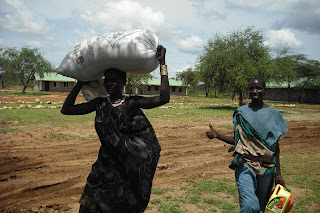
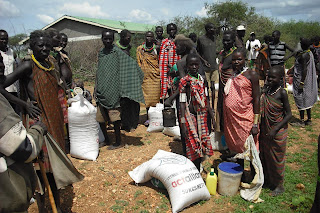
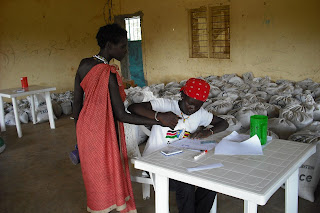
Right, so this picture has nothing to do with feeding programs, but it was on my camera and I thought Katie and Ryan would enjoy. This is our guard! On a series of consecutive rainy days, out came the UofM windbreaker. People were astonished that that coat was from "my place"--Sudanese-speak for your tribe's homeland.
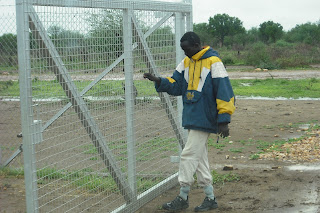
Dear Friends,
It's my pleasure to report the successful completion of our first day of food distribution. Today, 231 families from Katico Payam, Kapoeta South County, received roughly 13MT of sorghum, oil, and salt. A very talented and disciplined local staff upheld the highest standards of accountability, and the day passed peacefully, with both beneficiaries and chiefs walking away smiling.
Over the weekend, 8MT was delivered to 6 schools, and distributions are scheduled daily through this week and next. After that, we'll be back in the bomas/villages recording stories of our work (I already have a couple ideas), documenting food-for-work progress, and passing out cards for the next distribution.
Best,
Sarah


Right, so this picture has nothing to do with feeding programs, but it was on my camera and I thought Katie and Ryan would enjoy. This is our guard! On a series of consecutive rainy days, out came the UofM windbreaker. People were astonished that that coat was from "my place"--Sudanese-speak for your tribe's homeland.

Sunday, May 30, 2010
Catching up - Spring 2010
Things here are moving along. Though there have been a series of steps backward (that, really, is the MO of working in Sudan), I think I'm close to being able to do my first food distribution. The pictures below are of some of the people who will receive food.

In late April, one of Francis' employees (in fact, my favorite employee) had a baby--the first born son--that he named Francis. The picture below is visiting with Stephen's family. We brought them some groceries, a couple onesies (bought from the second-hand clothing "tarps" in the market because there were no infant clothes for sale in the regular shops) and a pair of new shoes for Sophie--their two-year-old. In visiting them, I was so happy and surprised to see the alphabet sign on the wall. It got me thinking that, while people are always asking me to buy clothes for their kids, I really should be giving them children's books. Any reading material is rare (and thus precious) in Sudan, but I've NEVER seen children's books. A recent trip to Nairobi had me spending hours in the book store picking out durable and Sudan-appropriate childrens books (stories of lions and hippos, but also a couple stories of fairy princesses because even little Sudanese girls need to dream.)

The delay in getting food for my project also gave Francis and me a chance to go on a short break in Kenya. We spent a day in Nairobi, dining at fancy restaurants and tool shopping (he was in heaven) and then went on a short safari for 3 days to Lake Nakuru. Though lions and leopards are reportedly there, the grass was too thick to see them. We did, however, see lots of zebras, buffalo, rhinos, flamingos, some giraffes (from afar) and a hyena (which is much bigger than The Lion King makes them out to be--they are somewhere between the size of a big dog and a small-ish bear).


In late April, one of Francis' employees (in fact, my favorite employee) had a baby--the first born son--that he named Francis. The picture below is visiting with Stephen's family. We brought them some groceries, a couple onesies (bought from the second-hand clothing "tarps" in the market because there were no infant clothes for sale in the regular shops) and a pair of new shoes for Sophie--their two-year-old. In visiting them, I was so happy and surprised to see the alphabet sign on the wall. It got me thinking that, while people are always asking me to buy clothes for their kids, I really should be giving them children's books. Any reading material is rare (and thus precious) in Sudan, but I've NEVER seen children's books. A recent trip to Nairobi had me spending hours in the book store picking out durable and Sudan-appropriate childrens books (stories of lions and hippos, but also a couple stories of fairy princesses because even little Sudanese girls need to dream.)

The delay in getting food for my project also gave Francis and me a chance to go on a short break in Kenya. We spent a day in Nairobi, dining at fancy restaurants and tool shopping (he was in heaven) and then went on a short safari for 3 days to Lake Nakuru. Though lions and leopards are reportedly there, the grass was too thick to see them. We did, however, see lots of zebras, buffalo, rhinos, flamingos, some giraffes (from afar) and a hyena (which is much bigger than The Lion King makes them out to be--they are somewhere between the size of a big dog and a small-ish bear).


Wednesday, April 14, 2010
Goodbye Negative Nancy
So, this blog has often recounted some of the more frustrating things about living in Sudan. It’s true; life here is hard, and sometimes scary (I found 2 more scorpions in the house this week), and generally challenging to get used to. However, living in Sudan hasn’t turned me into a super Negative Nancy. On the contrary, the last couple of months since we’ve been settled in our house have been some of the most satisfying months in my adult life—not the absolute best because, let’s be honest, nothing can really beat a year in Cambridge, but quite nice nevertheless. Now, I know that this seems like an outrageous statement since I live in a place of extreme poverty, no formal entertainment, and an overly circuitous path to get ANYTHING done. However, we are blessed to have both the means and foresight to overcome most of the hardships, while still enjoying the benefits of life off the grid (in more ways that one).
Take, for example, this week. It’s election week in Sudan—3 days (turned into 5) of voting followed by at least a couple days of counting ballots. The economic activity of the country is essentially at a standstill so that workers can vote. But, even with the classic Sudanese inefficiency, it doesn’t really take anyone 5 days to vote; people could take a day off (or maybe 3, if they need to travel home), but that is not the way around here. Much like Christmas time, people revel in extended holidays. Which is great for someone like me who has a job that relies entirely on input from Sudanese staff and liaising with government folks! I’ve had a week to just bum around the house. Sure, I’ve done some work: I’ve made curtains and some little beanbags to put at the base of exterior doors to keep out bugs and dirt, and I’ve helped out in the garden. But mostly I’ve been listening to news (and watching the last season of Grey’s Anatomy), cross stitching, and testing out new recipes. It’s been lovely. How can I ever go back to a paltry 2 weeks vacation, and 8 bank holidays in the US?
Speaking of the garden, holy cow—the harvest has come in. We can’t keep up with the yield of summer squash, cucumbers, green beans, butternut squash, snow peas, and cherry tomatoes (I’ve been getting about 2 pints every two days! I’m running out of things to do with these tomatoes!). I have regularly lamented about how I have missed winter and snow. However, in Sudan, it’s possible to have sweetcorn and veggies fresh from your garden year-round. That’s pretty nice. We did our first planting on November 18th (I remember because it’s Katie’s birthday!) and since then we’ve had 2 crops of cucumbers, corn, peas, and beans, and now that I’ve gotten a system down, we should have a near-continuous supply of all of the garden’s harvest starting next month. AMAZING! I think I would still prefer distinct seasons to a year-round growing season, but only just.
A third (and final for this blog) benefit of living in Sudan is a boost in our social life. Again, it’s a bit counter-intuitive since the social circle here is so much smaller than anywhere in the US (except perhaps the smallest Alaskan village). However, there’s very little after-work entertainment, and so we have much more time to devote to chatting with neighbors. Luckily, the expats that have found their way to this town are a very friendly bunch with great life stories, so it’s quite lovely to hang out. It’s given us a chance, too, to improve our hosting skills so hopefully we will return from the depths of Africa even more “cultured” than when we left.
So, the moral of the story is that it’s not all scorpions and heat waves here. Though I know many of you think we’re “roughing it”, sometimes I think that we’ve stumbled upon a corner of the world where it’s easier to live a more satisfying life.
Take, for example, this week. It’s election week in Sudan—3 days (turned into 5) of voting followed by at least a couple days of counting ballots. The economic activity of the country is essentially at a standstill so that workers can vote. But, even with the classic Sudanese inefficiency, it doesn’t really take anyone 5 days to vote; people could take a day off (or maybe 3, if they need to travel home), but that is not the way around here. Much like Christmas time, people revel in extended holidays. Which is great for someone like me who has a job that relies entirely on input from Sudanese staff and liaising with government folks! I’ve had a week to just bum around the house. Sure, I’ve done some work: I’ve made curtains and some little beanbags to put at the base of exterior doors to keep out bugs and dirt, and I’ve helped out in the garden. But mostly I’ve been listening to news (and watching the last season of Grey’s Anatomy), cross stitching, and testing out new recipes. It’s been lovely. How can I ever go back to a paltry 2 weeks vacation, and 8 bank holidays in the US?
Speaking of the garden, holy cow—the harvest has come in. We can’t keep up with the yield of summer squash, cucumbers, green beans, butternut squash, snow peas, and cherry tomatoes (I’ve been getting about 2 pints every two days! I’m running out of things to do with these tomatoes!). I have regularly lamented about how I have missed winter and snow. However, in Sudan, it’s possible to have sweetcorn and veggies fresh from your garden year-round. That’s pretty nice. We did our first planting on November 18th (I remember because it’s Katie’s birthday!) and since then we’ve had 2 crops of cucumbers, corn, peas, and beans, and now that I’ve gotten a system down, we should have a near-continuous supply of all of the garden’s harvest starting next month. AMAZING! I think I would still prefer distinct seasons to a year-round growing season, but only just.
A third (and final for this blog) benefit of living in Sudan is a boost in our social life. Again, it’s a bit counter-intuitive since the social circle here is so much smaller than anywhere in the US (except perhaps the smallest Alaskan village). However, there’s very little after-work entertainment, and so we have much more time to devote to chatting with neighbors. Luckily, the expats that have found their way to this town are a very friendly bunch with great life stories, so it’s quite lovely to hang out. It’s given us a chance, too, to improve our hosting skills so hopefully we will return from the depths of Africa even more “cultured” than when we left.
So, the moral of the story is that it’s not all scorpions and heat waves here. Though I know many of you think we’re “roughing it”, sometimes I think that we’ve stumbled upon a corner of the world where it’s easier to live a more satisfying life.
Tuesday, March 23, 2010
Change you (might not) Believe
Holy cow! Has it really been over a month since the last time I posted a blog?! Woah, I’m seriously slacking. Well, not really. I’ve actually been really busy—it’s amazing how quickly time goes by when you are working hard and playing Laura Ingals Wilder all at the same time!
So, on my last post, I talked about 3 changes—the passing of a beloved tortoise, the coming of the rains, and my new job feeding the masses. Well, as is wont to happen in Sudan, shortly after writing, all three things changed again!
Change back #1: Soon after Clare’s passing, we were given another tortoise. This one is tiny—about the size of a grown man’s palm—and he’s so cute! He is just small enough to fit between the house and the foundations for our air conditioning units, and so we call him AC. I like to think of it as a throw-back to Saved by the Bell and AC Slater—Francis is less keen on that idea. But anyway, AC it is.
Change back #2: So, it was apparently fake rains that came in mid-February. After about a week or so of sogginess and daily downpours, the rains stopped and were replaced by the “March winds”—I’ve been told there is a single word in Arabic for this phenomenon. These were serious sand-in-your-eyes, hold-onto-your-hat type winds. Crazy. Well, now at the end of March, it’s out with the winds and back with the rain. I’ve taken to carrying flipflops with me and just wearing my galoshes/wellies outside. The mud is so sticky that it turns any shoes into weights. Though my white boots make quite a fashion statement (I’ll try to post a picture soon), I figure it’s better than risking ruining another pair of flipflops.
Change back #3: So, I still have a job, but I’ve been seriously delayed in feeding the masses. For my project, we are supposed to be getting our food from the UN’s World Food Program (WFP) and essentially distributing it on their behalf. Well, because the hunger situation is so bad here, WFP has a mandate to get out a lot of food in a short time, and it really isn’t in their program to deal with us. We want to do things in an orderly, targeted way; they basically give the food over to a chief and let him distribute it however he wants (some do it fairly; some give only to family and friends). So anyway, we’ve been waiting and waiting for them to tell us when we get the food, and still no word. I’m used to Sudan and the waiting game, but this is particularly frustrating because #1 people are really hungry and #2 I’ve promised the chiefs that I’d feed their blind/lame/widowed people and I don’t want them to get mad at me!
Rather than stewing around here with nothing to do since I have no food to distribute, I took advantage of the lull in the project to travel with Francis to Kampala, Uganda. It was lovely to have good water pressure and not have to think a day in advance about what I was going to prepare for dinner (do I need to soak beans? Bake bread? Pick veggies from the garden or market?). Though I’ve never been much of a shopper, it also was lovely to stand in a grocery store and have 12 different types of (outrageously priced) cereal to choose from and stand in the canned fruit aisle dreaming of making peach cobbler. I even found Duncan Hines canned frosting! Though it was again outrageously expensive, I bought a couple cans for emergencies. And, I found a very nice Serbian hairdresser who knows how to cut khawaja hair! She even blow-dried and styled it! I felt like a queen!
Like all things in Africa, there were snafus. I think something died in our hotel room’s air-conditioner. Francis and I didn’t say anything because we were busy shopping all day and too tired to deal with it when we came back at night, but apparently guests were complaining (they thought we were stinky!) and so we changed rooms. Also, Francis had chartered a small plane to take cargo (and me!) directly home on Saturday. Well, it decided to fly half-empty on Thursday instead, so I had to make other arrangements. It included an overnight in Nairobi giving me a chance to get my long-awaited sushi, followed by fresh strawberries and cream, so all’s well that ends well.
I’m now back in Kapoeta alone for a week while Francis finishes shopping and I try to bust some chops (is that the right expression?) at WFP. As I told my mother, there’s no need to worry; there are six American men to protect me here on the compound. But after spending every day of the past six months within 2 miles of Francis (well, except when I was out in the bush, but thankfully I’ve always returned by dark), I miss him.
So, that’s the update here. The national elections in Sudan are in a couple of weeks, and so we’re still trying to figure out whether we will stay here or go on a short vacation—I’m voting either for a big-game safari experience or hiking the snow-capped Mount Kenya. I’m pretty sure that my project will take a break since there are only 5 staff members and I’m the only non-Sudanese (everyone else needs time off to travel to their home district to vote). But I’m not sure what Francis needs to do. Someone has to be around to run the generator and make sure all that (again, outrageously expensive) cheese we just bought in Kampala doesn’t spoil…
So, on my last post, I talked about 3 changes—the passing of a beloved tortoise, the coming of the rains, and my new job feeding the masses. Well, as is wont to happen in Sudan, shortly after writing, all three things changed again!
Change back #1: Soon after Clare’s passing, we were given another tortoise. This one is tiny—about the size of a grown man’s palm—and he’s so cute! He is just small enough to fit between the house and the foundations for our air conditioning units, and so we call him AC. I like to think of it as a throw-back to Saved by the Bell and AC Slater—Francis is less keen on that idea. But anyway, AC it is.
Change back #2: So, it was apparently fake rains that came in mid-February. After about a week or so of sogginess and daily downpours, the rains stopped and were replaced by the “March winds”—I’ve been told there is a single word in Arabic for this phenomenon. These were serious sand-in-your-eyes, hold-onto-your-hat type winds. Crazy. Well, now at the end of March, it’s out with the winds and back with the rain. I’ve taken to carrying flipflops with me and just wearing my galoshes/wellies outside. The mud is so sticky that it turns any shoes into weights. Though my white boots make quite a fashion statement (I’ll try to post a picture soon), I figure it’s better than risking ruining another pair of flipflops.
Change back #3: So, I still have a job, but I’ve been seriously delayed in feeding the masses. For my project, we are supposed to be getting our food from the UN’s World Food Program (WFP) and essentially distributing it on their behalf. Well, because the hunger situation is so bad here, WFP has a mandate to get out a lot of food in a short time, and it really isn’t in their program to deal with us. We want to do things in an orderly, targeted way; they basically give the food over to a chief and let him distribute it however he wants (some do it fairly; some give only to family and friends). So anyway, we’ve been waiting and waiting for them to tell us when we get the food, and still no word. I’m used to Sudan and the waiting game, but this is particularly frustrating because #1 people are really hungry and #2 I’ve promised the chiefs that I’d feed their blind/lame/widowed people and I don’t want them to get mad at me!
Rather than stewing around here with nothing to do since I have no food to distribute, I took advantage of the lull in the project to travel with Francis to Kampala, Uganda. It was lovely to have good water pressure and not have to think a day in advance about what I was going to prepare for dinner (do I need to soak beans? Bake bread? Pick veggies from the garden or market?). Though I’ve never been much of a shopper, it also was lovely to stand in a grocery store and have 12 different types of (outrageously priced) cereal to choose from and stand in the canned fruit aisle dreaming of making peach cobbler. I even found Duncan Hines canned frosting! Though it was again outrageously expensive, I bought a couple cans for emergencies. And, I found a very nice Serbian hairdresser who knows how to cut khawaja hair! She even blow-dried and styled it! I felt like a queen!
Like all things in Africa, there were snafus. I think something died in our hotel room’s air-conditioner. Francis and I didn’t say anything because we were busy shopping all day and too tired to deal with it when we came back at night, but apparently guests were complaining (they thought we were stinky!) and so we changed rooms. Also, Francis had chartered a small plane to take cargo (and me!) directly home on Saturday. Well, it decided to fly half-empty on Thursday instead, so I had to make other arrangements. It included an overnight in Nairobi giving me a chance to get my long-awaited sushi, followed by fresh strawberries and cream, so all’s well that ends well.
I’m now back in Kapoeta alone for a week while Francis finishes shopping and I try to bust some chops (is that the right expression?) at WFP. As I told my mother, there’s no need to worry; there are six American men to protect me here on the compound. But after spending every day of the past six months within 2 miles of Francis (well, except when I was out in the bush, but thankfully I’ve always returned by dark), I miss him.
So, that’s the update here. The national elections in Sudan are in a couple of weeks, and so we’re still trying to figure out whether we will stay here or go on a short vacation—I’m voting either for a big-game safari experience or hiking the snow-capped Mount Kenya. I’m pretty sure that my project will take a break since there are only 5 staff members and I’m the only non-Sudanese (everyone else needs time off to travel to their home district to vote). But I’m not sure what Francis needs to do. Someone has to be around to run the generator and make sure all that (again, outrageously expensive) cheese we just bought in Kampala doesn’t spoil…
Saturday, February 20, 2010
The times, they are a-changing
Where to begin? Shana’s visit really ushered in a whole new “normal” here.
Change #1: We are now a one-tortoise family. We arrived from picking up Shana at the airport in Kenya to find Clare, the first tortoise and the one that laid the eggs, dead in our backyard. For a couple days she’d been doing some serious hibernating, first on our porch and then on the edge of the tortoise pond. We try to let the tortoises do their own thing and so we’re not exactly sure when she died but she was pretty stiff (hence, the tortoise rigor mortis reference in the last post). I’m a little nervous now about caring for Morty, though he’s always been more active and at least once a week will eat up a storm on whatever grassy weeds are growing in the yard. If only there were a tortoise whisperer (or veterinarian!) in town to assure us that we’re not being bad tortoise tenders…
Change #2: The rains have come. Today marks the third rain in four days, turning this dusty town into a gooey mud bowl. Seriously, I have never experienced mud this sticky. The clumping of mud on your shoes is like walking around with 10-pounds on each foot. Since this mud is a sure way to kill a pair of flipflops (and makes for lots of dirt under your toenails) I’ve taken to wearing big rubber boots around—quite a fashion statement, I know. On the positive side, the rain thankfully has brought some relief from the heat and hopefully will keep the dust down in the house for a while.
Change #3: I am once again gainfully employed. Earlier this week, I started a job with an NGO organizing and overseeing emergency food distribution to 10,000 people living around Kapoeta. The rains never came last year, and so people have been running out of food. Today, I went to a boma (village) and found the grain stores empty; people have been eating these bitter almond-size fruits (like the ones on our Christmas tree) and tree leaves. It’s very sad. Most of this week I’ve been trying to pull together lists of people to receive the food, which included lots of meetings with government people and even a meeting with all of the local chiefs. [During this meeting, one of the chiefs indicated that he hoped after the program, his people would look “as healthy” as me. While at first I was appalled and embarrassed, I decided it better to take it as a sign of how lovely it is to be in a place where big is beautiful.] In the coming weeks, I need to hire myself a staff and work on putting together a system for efficiently and transparently distributing 970 metric tons (that’s 970,000 kg or about 2 million pounds!) of food. Needless to say, this food distribution job means that Francis and I won’t be having quite the gourmet meals we’ve become accustomed to while I’ve been playing housewife. But really, when you see people starving, even coming home to a peanut butter sandwich feels like a luxury.
Change #1: We are now a one-tortoise family. We arrived from picking up Shana at the airport in Kenya to find Clare, the first tortoise and the one that laid the eggs, dead in our backyard. For a couple days she’d been doing some serious hibernating, first on our porch and then on the edge of the tortoise pond. We try to let the tortoises do their own thing and so we’re not exactly sure when she died but she was pretty stiff (hence, the tortoise rigor mortis reference in the last post). I’m a little nervous now about caring for Morty, though he’s always been more active and at least once a week will eat up a storm on whatever grassy weeds are growing in the yard. If only there were a tortoise whisperer (or veterinarian!) in town to assure us that we’re not being bad tortoise tenders…
Change #2: The rains have come. Today marks the third rain in four days, turning this dusty town into a gooey mud bowl. Seriously, I have never experienced mud this sticky. The clumping of mud on your shoes is like walking around with 10-pounds on each foot. Since this mud is a sure way to kill a pair of flipflops (and makes for lots of dirt under your toenails) I’ve taken to wearing big rubber boots around—quite a fashion statement, I know. On the positive side, the rain thankfully has brought some relief from the heat and hopefully will keep the dust down in the house for a while.
Change #3: I am once again gainfully employed. Earlier this week, I started a job with an NGO organizing and overseeing emergency food distribution to 10,000 people living around Kapoeta. The rains never came last year, and so people have been running out of food. Today, I went to a boma (village) and found the grain stores empty; people have been eating these bitter almond-size fruits (like the ones on our Christmas tree) and tree leaves. It’s very sad. Most of this week I’ve been trying to pull together lists of people to receive the food, which included lots of meetings with government people and even a meeting with all of the local chiefs. [During this meeting, one of the chiefs indicated that he hoped after the program, his people would look “as healthy” as me. While at first I was appalled and embarrassed, I decided it better to take it as a sign of how lovely it is to be in a place where big is beautiful.] In the coming weeks, I need to hire myself a staff and work on putting together a system for efficiently and transparently distributing 970 metric tons (that’s 970,000 kg or about 2 million pounds!) of food. Needless to say, this food distribution job means that Francis and I won’t be having quite the gourmet meals we’ve become accustomed to while I’ve been playing housewife. But really, when you see people starving, even coming home to a peanut butter sandwich feels like a luxury.
Monday, February 15, 2010
A Q&A with Shana, our first visitor from the US

Q: What was your first impression of Kapoeta?
A: It is hot and in the middle of nowhere. Man, this is not like Yei.
Q: How hot is it?
A: Approximately 135 degrees Fahrenheit, regardless of the time of day. The heat is so hot it makes you sleep. You know it’s hot when your flipflops are sitting in the shade and they burn your feet when you put them on. You know it’s hot when you’re still sweating sitting inside of an air conditioned truck.
Q: What are the main differences from your trip to Yei in 2008?
A: It’s nice not having Joey’s workers all ask to marry me. Feeling safe enough to walk everywhere without being driven is pretty sweet, too.
Q: What was your favorite thing about the visit?
A: Seeing my brother and sister-in-law in the flesh. (Really?!) Oh, and having an entourage of people following me. And touching my muscles and my hair.
Q: What surprised you most?
A: How much Sarah has changed—she gets her hands in the dirt and she’s not afraid of bugs anymore.
Q: Any disappointments?
A: [said while waving a finger] The speed of the internet. Now I can understand why I can’t talk to my brother and sister-in-law whenever I want to. I am ticked.
Q: What was the saddest part of the trip?
A: It started with tortoise rigor mortis [details in my next blog] and ended with saying goodbye to Joey and Sarah.
Q: What was your scariest moment while visiting?
A: While you might think it was seeing the big military tank haulers, it was actually taking a long call (pooping) with a scorpion in the bathroom—at your house!
Q: What would people be amazed by?
A: The ability to make American food in this hell hole—just kidding, it’s not that bad. It’s just hot. Oh, wait, did I say that already? Seriously, it was some good eating.
Q: What three pictures would enquiring minds most like to see?
A. The pad.
The green garden—amongst this dry, desolate landscape.

The mountain view—not what you’d expect to see.

Q: What fixer-up would most improve the house?
A: Constant electricity and a closed-off porch so I don’t have to lock my room everytime I leave it, and a lock on the bathroom door so people don’t barge all up in your space. [Francis: “sorry”] …and maybe a tukul for the in-laws.
Q: What advice would you give to future visitors to Kapoeta?
A: Bring an umbrella—this joint ain’t got no shade. Also, bring some boxer briefs; this place ain’t suited for chub-rub. And pack clothes that hide the sweat, or no clothes at all and just sunscreen and the umbrella. Oh, and check your bedsheets before climbing under the covers—after my encounter with the scorpion, I reassessed the value of my life.
Q: How might a girl convince her brother to come visit?
A: One word: boobs. There are lots of them here. Oh, and they sell Smirnoff in town…
Q: How might we convince our mothers to come visit?
A: Have a baby.
…And on that note, the interview is done. Quite obviously, this girl is out of order, but was a VERY welcome guest, nevertheless.
Sunday, January 31, 2010
News from the frontier
As the newness of Sudan wears off and initially startling sights begin to become commonplace, it gets harder and harder to think of things that are noteworthy enough to write about. At the same time, though, I realize that the life I now lead is anything but ordinary. Francis and regularly reflect upon how our life here resembles that of pioneers: I bake bread and tend the garden, while he tries to construct and maintain our “homestead” with the most basic of tools. I like to think of myself as the modern-day Laura Ingals Wilder while Francis channels Speke or Livingstone, some of the early African explorers.
In coming up with fodder for this post, I realize I have neglected to mention that there has been some upheaval in the Mills’ pet situation. A couple weeks ago, we were driving through town when a dumptruck driver who has hauled topsoil for me flagged us down to tell us he had dropped off a tortoise at our house. Thinking that he expected payment, we gave him some non-committal answer, but he clarified that it “was a gift for madam.” After searching for a couple days (this new addition is MUCH quicker) we found our gift roaming around the powerstation grounds just outside our residential compound fence. Since we’d given up on using visual indicators to determine tortoise gender, we christened him Clare, either short for Clarence (an excellent name for a tortoise, don’t you think?!) or a nice female name. Well, two weeks passed and we found the old tortoise Morty laying more eggs, thus firmly establishing that “she” is a she. While I thought that Morty would still be ok (short for Morticia…), Francis insisted that we swap the pet names. So now the old Morty, the egg-layer with the cracked shell, goes by Clare and the new guy who is much less shy (he’s taken a liking to hanging out on the front porch) is the new Morty. It’s almost like a soap opera, huh?!
The addition of the second tortoise provided further impetus to construct a pond for the tortoises. Though they are accustomed to desert living and spend most of the day hiding in a shady spot, online sources say that leopard tortoises do like to have a shallow place to wade in and have a nice long drink. I had Peter do some excavation, and hired a mason to pour a shallow pond, and then Francis and I pushed some large, pretty stones in the surface of the wet concrete Cambridge-style. I then took LOTS of extra stones and put them around the concrete to create ramps for the tortoises to enter and exit. So far, the birds have gotten much more use out of it than Morty or Clare (in fact, I don’t think Morty likes water much at all), though Clare spent a good hour in the pond the other day. I have plans to plant bushes on one side to provide additional hiding spots and grass all around so they have something to eat, all in due time.
In other news, while I was out in the yard arranging the stones around the pond, I noticed a 10 or 12 year old Toposa girl outside our fence. Now, there are young Toposa girls passing by the compound all the time, but this one caught my eye because rather than staring in the compound at me, she was looking up at one of the trees just outside our fence. While I watched her, she picked up a rock and hurled it up into the tree canopy. An instant later, a crow-sized bird fell from the tree, which she promptly picked up and went on her way. Now, I know that for eons humans have been killing birds with stones, but I thought that it was mostly done with the aid of a slingshot. This wasn’t just a random happening—this girl was tracking her prey, aiming, and got it in one try! I was impressed. These people are tough.
In other news, we’ve now been officially moved into our house for about a week. On one of the first nights in the house, an American friend who we met in November at the safari camp was in town again, and so we invited him over for dinner, making him our first dinner guest. The meal, if I must say so myself (and evidenced by no leftovers) was quite lovely, but it was even lovelier sitting around on the couch after dinner, sipping tea (me) and port (Francis). It felt so civilized after months of living out of a suitcase.
Though we received clearance to move in, there were still a couple things around the house that the construction contractor needed to finish. As per Murphy’s Law, they showed up three days after this move-in. Even worse, it was the night before my birthday, and their top priority for the following day was to seal the grout throughout the house. So, I awoke on my 28th b-day on the wrong side of the bed, and watched as a team of people removed from the house EVERYTHING that I had just put in place. I was mad. I needed to get away, and it just so happened that Peter also had finally lined up a source for manure for the garden, and so I had a crappy (pun intended) rest of the morning collecting poop to feed my plants. The day improved a bit when I got a call that an NGO doing emergency food distribution out in the bush around Kapoeta (there was a drought last year and its effects are really starting to show now) wanted to interview me for a position coordinating distribution—more details later if it actually happens. The next step in the right direction was realizing that my sweetcorn was ready (actually, beyond ready) for picking! I’d hoped for corn-on-the-cob for a birthday meal, but didn’t really think it would be possible. Oh, what a harvest! Against all odds, I managed to reap about 4 dozen ears (only from those plants that I didn’t transplant—lesson for the future), a dozen of which Francis and I consumed off the cob and the rest which I cooked, cut off the cob, and have stored in the freeze for future enjoyment. The next day, I had Peter plant more (I’m thinking we’ll plant every two or three weeks, now that we know it works!).
Anyway, back to the birthday story. So, things improved with the sweetcorn, as well as with the mudslide that I had for dessert. To top the day off, I went online to find an overwhelming number of emails and facebook messages from family and friends, leading me to wonder who died and made me so popular?! I also opened physical birthday cards (sent earlier with Francis’ colleagues) from Mama & Papa Mills (Thank you!) and my parents (who would have thought that your voices would be heard in Africa?!). It turned out to be a lovely day.
Later in the week, the contractors finished up on the house, and Francis and I made our way to Juba where I’m writing this post. He has a work meeting and needs to do some shopping for the project, and I had my interview (went well, I think) and need to pick up some groceries. We also met up with the 5 American linemen who have been contracted to do most of the actual construction of power lines, and we’ll all be traveling back “home” in a couple days.
I expect lots of excitement in the coming weeks, not the least of which is a visit from Shana (Francis’ sister). We’re due to get the heck out of Sudan in the next couple weeks (actually, Juba was a welcome change of scenery, even if it is a dump), though I’m not sure that a trip to Nairobi or Kampala will be possible if I get this job—there is LOTS to be done in a short time. Anyway, stay posted for the latest news and don’t worry if I don’t post; just means that I’m back to being a boring pioneer...
In coming up with fodder for this post, I realize I have neglected to mention that there has been some upheaval in the Mills’ pet situation. A couple weeks ago, we were driving through town when a dumptruck driver who has hauled topsoil for me flagged us down to tell us he had dropped off a tortoise at our house. Thinking that he expected payment, we gave him some non-committal answer, but he clarified that it “was a gift for madam.” After searching for a couple days (this new addition is MUCH quicker) we found our gift roaming around the powerstation grounds just outside our residential compound fence. Since we’d given up on using visual indicators to determine tortoise gender, we christened him Clare, either short for Clarence (an excellent name for a tortoise, don’t you think?!) or a nice female name. Well, two weeks passed and we found the old tortoise Morty laying more eggs, thus firmly establishing that “she” is a she. While I thought that Morty would still be ok (short for Morticia…), Francis insisted that we swap the pet names. So now the old Morty, the egg-layer with the cracked shell, goes by Clare and the new guy who is much less shy (he’s taken a liking to hanging out on the front porch) is the new Morty. It’s almost like a soap opera, huh?!
The addition of the second tortoise provided further impetus to construct a pond for the tortoises. Though they are accustomed to desert living and spend most of the day hiding in a shady spot, online sources say that leopard tortoises do like to have a shallow place to wade in and have a nice long drink. I had Peter do some excavation, and hired a mason to pour a shallow pond, and then Francis and I pushed some large, pretty stones in the surface of the wet concrete Cambridge-style. I then took LOTS of extra stones and put them around the concrete to create ramps for the tortoises to enter and exit. So far, the birds have gotten much more use out of it than Morty or Clare (in fact, I don’t think Morty likes water much at all), though Clare spent a good hour in the pond the other day. I have plans to plant bushes on one side to provide additional hiding spots and grass all around so they have something to eat, all in due time.
In other news, while I was out in the yard arranging the stones around the pond, I noticed a 10 or 12 year old Toposa girl outside our fence. Now, there are young Toposa girls passing by the compound all the time, but this one caught my eye because rather than staring in the compound at me, she was looking up at one of the trees just outside our fence. While I watched her, she picked up a rock and hurled it up into the tree canopy. An instant later, a crow-sized bird fell from the tree, which she promptly picked up and went on her way. Now, I know that for eons humans have been killing birds with stones, but I thought that it was mostly done with the aid of a slingshot. This wasn’t just a random happening—this girl was tracking her prey, aiming, and got it in one try! I was impressed. These people are tough.
In other news, we’ve now been officially moved into our house for about a week. On one of the first nights in the house, an American friend who we met in November at the safari camp was in town again, and so we invited him over for dinner, making him our first dinner guest. The meal, if I must say so myself (and evidenced by no leftovers) was quite lovely, but it was even lovelier sitting around on the couch after dinner, sipping tea (me) and port (Francis). It felt so civilized after months of living out of a suitcase.
Though we received clearance to move in, there were still a couple things around the house that the construction contractor needed to finish. As per Murphy’s Law, they showed up three days after this move-in. Even worse, it was the night before my birthday, and their top priority for the following day was to seal the grout throughout the house. So, I awoke on my 28th b-day on the wrong side of the bed, and watched as a team of people removed from the house EVERYTHING that I had just put in place. I was mad. I needed to get away, and it just so happened that Peter also had finally lined up a source for manure for the garden, and so I had a crappy (pun intended) rest of the morning collecting poop to feed my plants. The day improved a bit when I got a call that an NGO doing emergency food distribution out in the bush around Kapoeta (there was a drought last year and its effects are really starting to show now) wanted to interview me for a position coordinating distribution—more details later if it actually happens. The next step in the right direction was realizing that my sweetcorn was ready (actually, beyond ready) for picking! I’d hoped for corn-on-the-cob for a birthday meal, but didn’t really think it would be possible. Oh, what a harvest! Against all odds, I managed to reap about 4 dozen ears (only from those plants that I didn’t transplant—lesson for the future), a dozen of which Francis and I consumed off the cob and the rest which I cooked, cut off the cob, and have stored in the freeze for future enjoyment. The next day, I had Peter plant more (I’m thinking we’ll plant every two or three weeks, now that we know it works!).
Anyway, back to the birthday story. So, things improved with the sweetcorn, as well as with the mudslide that I had for dessert. To top the day off, I went online to find an overwhelming number of emails and facebook messages from family and friends, leading me to wonder who died and made me so popular?! I also opened physical birthday cards (sent earlier with Francis’ colleagues) from Mama & Papa Mills (Thank you!) and my parents (who would have thought that your voices would be heard in Africa?!). It turned out to be a lovely day.
Later in the week, the contractors finished up on the house, and Francis and I made our way to Juba where I’m writing this post. He has a work meeting and needs to do some shopping for the project, and I had my interview (went well, I think) and need to pick up some groceries. We also met up with the 5 American linemen who have been contracted to do most of the actual construction of power lines, and we’ll all be traveling back “home” in a couple days.
I expect lots of excitement in the coming weeks, not the least of which is a visit from Shana (Francis’ sister). We’re due to get the heck out of Sudan in the next couple weeks (actually, Juba was a welcome change of scenery, even if it is a dump), though I’m not sure that a trip to Nairobi or Kampala will be possible if I get this job—there is LOTS to be done in a short time. Anyway, stay posted for the latest news and don’t worry if I don’t post; just means that I’m back to being a boring pioneer...
Friday, January 15, 2010
Flat-pack queen and garden goddess
It has been a week now since the truck with our furniture and appliances arrived from Uganda, and since then we’ve been spending no less than 12 hours a day (some time 14 or 15) trying to get things in order to move in. The bulk of my time (and the bane of my existence) has been putting together loads of flat-pack furniture—you know, Ikea/Target-style press board dressers, etc. Back in the States, I wasn’t too keen on this stuff because there is inevitably at least one piece where the holes are drilled incorrectly and, let’s be honest, I certainly don’t have the wrist strength to drive in a gazillion little screws to make the thing all fit together. It’s even harder here in Africa when the diagrams for assembly are incomprehensible (even to a reasonably intelligent engineer). After a week, I have 3 of 4 wardrobes completed (the first took 2 days to assemble!) and 4 of 8 desks put together. I also expected to put together bed frames, but we quickly realized that the store had shipped us queen-sized bed frames and California-king-sized mattresses. Since it’s not like we can go down the street to do an exchange—shipping them back to Uganda would cost more than they are worth—we’ve just been sleeping on the mattress on the floor. But since it’s the first time we’ve had a spring mattress to sleep on in 3 months, I’m not complaining!
With the truck of goodies also came everything to make a functional kitchen. I spent an entire day on Thursday washing dishes and trying to find a home for the pots, pans, and small appliances, no small task considering that I have approximately 6 square feet of countertop space and about half enough cupboards. With everything in place, I then set out to make a birthday dinner for Francis—though his bday is the 4th, since I had no means to bake a cake or good meal, we opted to observe his birthday 10 days later. It was so nice to be back in a kitchen with a handmixer, measuring cups, and frying pan!!! I’d planned on making frosted brownies and was lucky to find fresh eggs in the market. I also made a tomato and pesto lasagna, with basil from my own garden. The food was almost as good as the enjoyment of making it!
Speaking of the garden, everything is “going gangbusters” as my padre likes to say. We have enough green beans for a meal about every three days, the first batch of peas should be ready to pick any day, and there are four cucumbers that should also be ready soon. We have a few marble-sized tomatoes and some golf ball-sized watermelons. I’m expecting the beets also to be ready soon, but I think the carrots and onions need some more time. The eggplant and peppers look healthy, but still no signs of fruit—it seems, though, that it’s a late bloomer ( and I’ve only planted it 2 months ago). I’m not sure what to make of my sweetcorn—it all looks healthy, but I’m afraid that it tassled too early. The tallest stalks are about 5’ tall, and even some of the 3-footers have full tassles. I have been warned that the 12-hour days (as opposed to the Midwest’s 16-18 hours of summer sun) may not be enough to produce full ears, but the thought of crispy, sweet corn-on-the-cob is worth the effort of trying. The only real disappointment (outside of my strawberries which never germinated) is my zucchini; the plants look healthy and they get huge yellow blossoms, but so far absolutely no fruit! Now that we’ve begun to see what grows well, the gardener and I are working this week on expanding the garden by about 50% so that we can get the next batch of crops in. Now that we’ve had crunchy, fresh veggies, we want to ensure that we will always have some!
[Above: Peter the gardener with our 3rd batch of beans]
Not too much else to report here. Furniture assembly has delayed my job hunt a bit, though I did have a pretty promising talk with an NGO the other day. I’m hoping that by the end of the month the house will be in good enough shape to throw a party for all of the kawajas in town …and not let anyone leave until someone agrees to hire me.
With the truck of goodies also came everything to make a functional kitchen. I spent an entire day on Thursday washing dishes and trying to find a home for the pots, pans, and small appliances, no small task considering that I have approximately 6 square feet of countertop space and about half enough cupboards. With everything in place, I then set out to make a birthday dinner for Francis—though his bday is the 4th, since I had no means to bake a cake or good meal, we opted to observe his birthday 10 days later. It was so nice to be back in a kitchen with a handmixer, measuring cups, and frying pan!!! I’d planned on making frosted brownies and was lucky to find fresh eggs in the market. I also made a tomato and pesto lasagna, with basil from my own garden. The food was almost as good as the enjoyment of making it!
Speaking of the garden, everything is “going gangbusters” as my padre likes to say. We have enough green beans for a meal about every three days, the first batch of peas should be ready to pick any day, and there are four cucumbers that should also be ready soon. We have a few marble-sized tomatoes and some golf ball-sized watermelons. I’m expecting the beets also to be ready
 soon, but I think the carrots and onions need some more time. The eggplant and peppers look healthy, but still no signs of fruit—it seems, though, that it’s a late bloomer ( and I’ve only planted it 2 months ago). I’m not sure what to make of my sweetcorn—it all looks healthy, but I’m afraid that it tassled too early. The tallest stalks are about 5’ tall, and even some of the 3-footers have full tassles. I have been warned that the 12-hour days (as opposed to the Midwest’s 16-18 hours of summer sun) may not be enough to produce full ears, but the thought of crispy, sweet corn-on-the-cob is worth the effort of trying. The only real disappointment (outside of my strawberries which never germinated) is my zucchini; the plants look healthy and they get huge yellow blossoms, but so far absolutely no fruit! Now that we’ve begun to see what grows well, the gardener and I are working this week on expanding the garden by about 50% so that we can get the next batch of crops in. Now that we’ve had crunchy, fresh veggies, we want to ensure that we will always have some!
[Above: Peter the gardener with our 3rd batch of beans]
Not too much else to report here. Furniture assembly has delayed my job hunt a bit, though I did have a pretty promising talk with an NGO the other day. I’m hoping that by the end of the month the house will be in good enough shape to throw a party for all of the kawajas in town …and not let anyone leave until someone agrees to hire me.
Tuesday, January 5, 2010
Green Beans and Girl Friends
Living in Sudan is all about seeing life in its rawest form: naked (literally), unrefined, un-cushioned. Rather than fighting against nature, the Sudanese, whether out of necessity or immense wisdom, have learned to not fight against the harshness of the world, but rather to live with it. There is no such concept as a “well-sealed” house. This is an indoor-outdoor living culture with usually only sleeping done under the protection of a roof. Kids aren’t coddled but rather are expected to work for their keep. Even the smallest toddlers wander around lugging jerry cans. By the time they are 5 or 6, girls are expected to care for weaned infants, carrying a baby half their size around on their backs. Animals are valued solely for the meat that they can provide or the dowry they can buy. Goats are pulled around by their horns or hind legs, while chickens tend to by carried around upside down by their feet or (not too uncommonly) by just one wing. (Boy, do I have stories for PETA). It’s a place filled with acacia trees and their accompanying slightly-toxic thorns.
It’s understandable, then, why Sudan is a difficult place to love. What I’ve come to discover, though, is that such an atmosphere allows you to really appreciate simple joys.
…Like green beans. Fresh out of the garden, warm, crunchy, green beans. Today Francis and I enjoyed the first fruits of our garden. After two months of (kidney) beans, rice, and fried potatoes, the fresh, crisp flavor of the green beans was like candy. I had vowed to take a picture of my first harvest, but once I started eating the green beans, I couldn’t stop. Maybe you’ll get a picture of the second harvest.
…Like having a girlfriend. Someone you can sit across the coffeetable from with your feet curled under you, and chat about whatever is on your mind: recipes, frustrations of being stared at by Toposa women, which stores in town sell the best bread. Not that Francis’ company isn’t lovely (seriously, I would have already bought a ticket back to the US if I didn’t think so) but having someone to have girl-talk with is something that truly is a blessing.
…Like drink mixes. Tang, Kool-Aid, Crystal Lite. In such a climate, your body requires A LOT of liquid. But seriously, you can only drink so much room-temperature water. What a joy it is to tip back a glass and have sweet liquid tickle your tongue! Thank you NASA or whoever it was that came up with Tang and all of the other powdered drinks after it.
So, that’s what I’ve got right now. No huge news this week. Our stuff is still not here so we are splitting our time (and meals) between our empty house and the safari camp. With everyone returning from Christmas, I’m back to supervising crews doing excavations/leveling around the compound and plan to resume my job hunting. Wish me luck…
It’s understandable, then, why Sudan is a difficult place to love. What I’ve come to discover, though, is that such an atmosphere allows you to really appreciate simple joys.
…Like green beans. Fresh out of the garden, warm, crunchy, green beans. Today Francis and I enjoyed the first fruits of our garden. After two months of (kidney) beans, rice, and fried potatoes, the fresh, crisp flavor of the green beans was like candy. I had vowed to take a picture of my first harvest, but once I started eating the green beans, I couldn’t stop. Maybe you’ll get a picture of the second harvest.
…Like having a girlfriend. Someone you can sit across the coffeetable from with your feet curled under you, and chat about whatever is on your mind: recipes, frustrations of being stared at by Toposa women, which stores in town sell the best bread. Not that Francis’ company isn’t lovely (seriously, I would have already bought a ticket back to the US if I didn’t think so) but having someone to have girl-talk with is something that truly is a blessing.
…Like drink mixes. Tang, Kool-Aid, Crystal Lite. In such a climate, your body requires A LOT of liquid. But seriously, you can only drink so much room-temperature water. What a joy it is to tip back a glass and have sweet liquid tickle your tongue! Thank you NASA or whoever it was that came up with Tang and all of the other powdered drinks after it.
So, that’s what I’ve got right now. No huge news this week. Our stuff is still not here so we are splitting our time (and meals) between our empty house and the safari camp. With everyone returning from Christmas, I’m back to supervising crews doing excavations/leveling around the compound and plan to resume my job hunting. Wish me luck…
Monday, December 28, 2009
Our First (Kapoeta) Christmas
When it’s consistently 90 degrees outside and you live in a place where people can’t afford even the cheapest holiday decorations (and you have no house in which to unpack your decorations), Christmas has a way of sneaking up on you. But, as the world over, Christmas did come to Kapoeta, and Francis and I made the most of our first Christmas as a family.
On Christmas Eve, we spent the morning at our still-empty house. I was determined that I’d wake up Christmas morning to a hot shower, something other than crepes for breakfast, and to some place that felt a little more like home. So, we set up an air mattress and the camping stove, and pulled out the small box of Christmas decorations that we’d sent from the States. While I hung our stockings and some ornaments from the still-empty curtain rods, Francis scavenged the brush pile for a suitable Christmas tree [he opted for what he later identified as a Desert Date—it did have thorns, but not nearly as many as some of the other options]. Later in the afternoon on Christmas Eve, we were invited to have snacks at the house of an
  American missionary couple [they are about the same age as us and have three little boys. Though our paths have seldom crossed since we arrived in town, the wife and I have exchanged many emails over the last few months. She really is a kindred spirit (alleluia!) and so I’m sure you’ll hear more about her in future posts.] Though not exactly a traditional Christmas gathering (there was pepperoni pizza, beefy cheese dip, and fudgy brownies!), it was so nice to commiserate with others who are craving some of the same American goodies that I miss, experimenting with gardening, and (even more importantly) struggling with the reality of being someone who “has” in a land of “have-nots”.
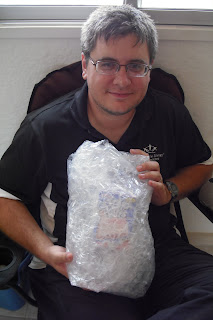
[Pictures: my attempt at decorating an unfurnished house; gifts for the American boys (poptarts in bubble wrap]
As advertised, we woke up Christmas morning in our new house, though not without some glitches. First off, the air mattress that we had borrowed had sprung a slow leak, and so we woke up at 4am essentially sleeping on the tile floor. Around that same time, we realized that even the nighttime in Kapoeta is hot—we’d shut off the generator (and thus the air-conditioner and any fans) at bedtime, but the house still managed to absorb heat. I re-inflated the mattress while Francis turned on the generator, and we went back to sleep for a bit before Francis was awakened because one of the compound guards hadn’t shown up for duty. When he returned from handling that situation, we had our first meal in our new house (cereal, juice, and some bread made by my new friend), and opened cards and presents. Then we headed for church. Now, as I’ve previously reported, Mass is typically 2 hours long because everything is done in 2 languages, and so I’d prepared myself for an extended service. We arrived to the church 20 minutes early to find it 75% full—it was 100% over capacity by the time mass started and there were even more people outside the church when we left. I was at first embarrassed when we were ushered to the VIP seats (plastic Africa chairs on the side facing the altar, rather than the typical backless wooden benches), but realized it was a blessing after sitting through a nearly 3-hour service (plus, it provided an excellent view for people-watching). The church itself had what I think were the only Christmas decorations in town (if you don’t count my imported stash)—a 3’ fake tree with some lights and lots of foil decorations on the altar, and prayer-flag-type streamers strung throughout. I was slightly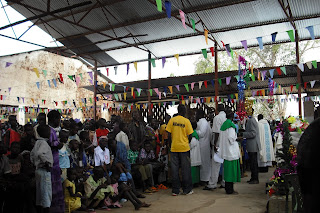 disappointed that there wasn’t the pageantry and costumes that I was warned about. But it wasn’t without excitement. Mass was interrupted at one point by a parade of people marching (and singing) through the back of the church. There was a crazy old man wrapped in a mosquito bed-net who regularly stood right in front of the alter waving his (only) arm and admonishing little kids to be quiet. In the middle of the homily, the priest led the (predominantly non-English-speaking) congregation in a rousing rendition of “Number one, Jesus is number one...”. And announcements included 30+ minutes of speeches from politicians (and political hopefuls) who were back in their home district for the holiday, and eager to talk to their constituents, many of whom I’d imagine rarely make it into town. After mass, we visited some friends at the Pentecostal mission (they fed 500+ people after their Christmas service), made phone calls to the family (our Christmas night; their late-morning), and then joined the same friends at the safari camp for a turkey dinner (which was very juicy but served, of course, with French fries, rice, and a bean medley).
The day after Christmas (Boxing Day, as our British friends call it) was our first anniversary. We headed back over to our house, fired up the generator, and had a lovely day simply relaxing. I’d gotten Francis a book on East African trees, and so he spent the better part of the day identifying which species we have on our compound. I caught up on some of the news (via podcast) and cross-stitched. In the evening, we made dinner on the campstove (couscous with artichoke pesto and sundried-tomatoes). It’s amazing how quickly a year goes by, but also how much can change in just one year!


[Pictures: This year and last]
Thank you to everyone who has sent holiday and anniversary well-wishes, particularly since I’ve been delinquent in sending any sort of Christmas greeting (electronic or otherwise). My New Year’s resolution: to do better. Enjoy the winter weather for me!
On Christmas Eve, we spent the morning at our still-empty house. I was determined that
 I’d wake up Christmas morning to a hot shower, something other than crepes for breakfast, and to some place that felt a little more like home. So, we set up an air mattress and the camping stove, and pulled out the small box of Christmas decorations that we’d sent from the States. While I hung our stockings and some ornaments from the still-empty curtain rods, Francis scavenged the brush pile for a suitable Christmas tree [he opted for what he later identified as a Desert Date—it did have thorns, but not nearly as many as some of the other options]. Later in the afternoon on Christmas Eve, we were invited to have snacks at the house of an
  American missionary couple [they are about the same age as us and have three little boys. Though our paths have seldom crossed since we arrived in town, the wife and I have exchanged many emails over the last few months. She really is a kindred spirit (alleluia!) and so I’m sure you’ll hear more about her in future posts.] Though not exactly a traditional Christmas gathering (there was pepperoni pizza, beefy cheese dip, and fudgy brownies!), it was so nice to commiserate with others who are craving some of the same American goodies that I miss, experimenting with gardening, and (even more importantly) struggling with the reality of being someone who “has” in a land of “have-nots”.
[Pictures: my attempt at decorating an unfurnished house; gifts for the American boys (poptarts in bubble wrap]
As advertised, we woke up Christmas morning in our new house, though not without some glitches. First off, the air mattress that we had borrowed had sprung a slow leak, and so we woke up at 4am essentially sleeping on the tile floor. Around that same time, we realized that even the nighttime in Kapoeta is hot—we’d shut off the generator (and thus the air-conditioner and any fans) at bedtime, but the house still managed to absorb heat. I re-inflated the mattress while Francis turned on the generator, and we went back to sleep for a bit before Francis was awakened because one of the compound guards hadn’t shown up for duty. When he returned from handling that situation, we had our first meal in our new house (cereal, juice, and some bread made by my new friend), and opened cards and presents. Then we headed for church. Now, as I’ve previously reported, Mass is typically 2 hours long because everything is done in 2 languages, and so I’d prepared myself for an extended service. We arrived to the church 20 minutes early to find it 75% full—it was 100% over capacity by the time mass started and there were even more people outside the church when we left. I was at first embarrassed when we were ushered to the VIP seats (plastic Africa chairs on the side facing the altar, rather than the typical backless wooden benches), but realized it was a blessing after sitting through a nearly 3-hour service (plus, it provided an excellent view for people-watching). The church itself had what I think were the only Christmas decorations in town (if you don’t count my imported stash)—a 3’ fake tree with some lights and lots of foil decorations on the altar, and prayer-flag-type streamers strung throughout. I was slightly
 disappointed that there wasn’t the pageantry and costumes that I was warned about. But it wasn’t without excitement. Mass was interrupted at one point by a parade of people marching (and singing) through the back of the church. There was a crazy old man wrapped in a mosquito bed-net who regularly stood right in front of the alter waving his (only) arm and admonishing little kids to be quiet. In the middle of the homily, the priest led the (predominantly non-English-speaking) congregation in a rousing rendition of “Number one, Jesus is number one...”. And announcements included 30+ minutes of speeches from politicians (and political hopefuls) who were back in their home district for the holiday, and eager to talk to their constituents, many of whom I’d imagine rarely make it into town. After mass, we visited some friends at the Pentecostal mission (they fed 500+ people after their Christmas service), made phone calls to the family (our Christmas night; their late-morning), and then joined the same friends at the safari camp for a turkey dinner (which was very juicy but served, of course, with French fries, rice, and a bean medley).
The day after Christmas (Boxing Day, as our British friends call it) was our first anniversary. We headed back over to our house, fired up the generator, and had a lovely day simply relaxing. I’d gotten Francis a book on East African trees, and so he spent the better part of the day identifying which species we have on our compound. I caught up on some of the news (via podcast) and cross-stitched. In the evening, we made dinner on the campstove (couscous with artichoke pesto and sundried-tomatoes). It’s amazing how quickly a year goes by, but also how much can change in just one year!


[Pictures: This year and last]
Thank you to everyone who has sent holiday and anniversary well-wishes, particularly since I’ve been delinquent in sending any sort of Christmas greeting (electronic or otherwise). My New Year’s resolution: to do better. Enjoy the winter weather for me!
Saturday, December 19, 2009
News from Kapoeta
There hasn't been much of note going on recently, and so I thought I'd report some of my observations of the mundane, Garrison-Keilor-style. Here goes ...
It's been a quiet week in Kapoeta, my (new) hometown at the edge of the dry savannah.
The November rains have finally come-albeit a little late-providing some respite from the heat and greening the landscape. While most of the rains have been occasional mid-day sprinkles, on Friday there was a heavy downpour. I'm not sure if it was the impact of the raindrops on the earth or steam from cool rain hitting soil, but all of Kapoeta was blanketed with a white, misty fog; it's as close to snow as this town gets. Within an hour, the usually dry and passable riverbed was full of rushing water, impassable to all but the intrepid (or foolish) for the next 5 hours. (To get a sense of these river crossings, I've posted a picture of one of my favorites on the drive to Loki.)a white, misty fog; it’s as close to snow as this town gets. Within an hour, the usually dry and passable riverbed was full of rushing water, impassable to all but the intrepid (or foolish) for the next 5 hours. (To get a sense of these river crossings, I’ve posted a picture of one of my favorites on the drive to Loki.)
On Sunday at the Catholic Church, the Toposa lector for the first reading was a middle age woman, straight out of the bush. Now, St. Mary's Catholic Church in Kapoeta is no stranger to topless women, but this was the first I'd seen of it at the lectern. This lector also doubled as a liturgical dancer, standing up in the center aisle anytime music was played, occasional sashaying over to dance in front of the choir or right in front of the alter. While I'd been told that music is a key part of Toposa culture, this was the first I'd witnessed dancing, mostly swaying and bopping to the drum beat, and occasionally rotating shoulders and arms so that the arm bands with 2 'long grass tassels would flip up over and around the dancer's biceps. Later in the week I passed an entire troupe of dancers, presumably practicing for Christmas festivities.
Christmas is a big deal in Kapoeta. There are no visible signs to mark its coming, no light strands or tacky lawn displays; not even an advent wreath in the church. However, its coming is palpable in the air. In town, I've noticed more people wearing new wraps, the clean material striking in dust-coated world. Many of the shops in town have new stocks of thin linoleum to be rolled out on the dirt floor of a tukul. The atmosphere at the worksite reminds me of May in high school, anticipating the end of the school year. All of the boys are itching to be done, talking about their holiday travel plans to see their mothers, scheming about ways that they might be able to skip out early. Francis and I have begun distributing Christmas cards to some of the regular workers. While I can't say it is the first time they've received a Christmas card, the look on their face after receiving an envelope with their name written on it reveals that this is certainly not an everyday occurrence for them.
Christmas came a little early for the Mills family this year. Our shipment of personal effects arrived from the US on Monday. Since the contractor is still making repairs in the house and we don't yet have shelves to unpack the boxes onto, most of the things have remained wrapped in their packing. We have pulled out the CD case to start playing some Christmas tunes, though (I think part of my malaise has been due to a lack of music) and I've identified some of the boxes that we'll want to have access to in order to celebrate Christmas. Now that our camping gear has arrived, even if we don't have furniture, we intend to wake up in our house on Christmas morning.
With each passing day, the house gets closer to being moved into. On Tuesday they fixed the shower, and so I was able to take my first flip-flop-free, hot-water shower in Kapoeta. It was heavenly. The garden out back is also going full-tilt. Peter and I transplanted the tomatoes on Wednesday. I tried to get him to give some of the extra plants to the workers, but he insisted that I transplant all 50 + plants, noting that no one else has ready access to water to keep them thriving. Seeing his point, I reluctantly agreed; even if I give all of the workers tomatoes, something tells me I may still have enough to set up a vegetable stand.
Well, that's the news from Kapoeta, where the women are poised, the men are often absent, and the children are all half-naked.
It's been a quiet week in Kapoeta, my (new) hometown at the edge of the dry savannah.
The November rains have finally come-albeit a little late-providing some respite from the heat and greening the landscape. While most of the rains have been occasional mid-day sprinkles, on Friday there was a heavy downpour. I'm not sure if it was the impact of the raindrops on the earth or steam from cool rain hitting soil, but all of Kapoeta was blanketed with a white, misty fog; it's as close to snow as this town gets. Within an hour, the usually dry and passable riverbed was full of rushing water, impassable to all
 but the intrepid (or foolish) for the next 5 hours. (To get a sense of these river crossings, I've posted a picture of one of my favorites on the drive to Loki.)a white, misty fog; it’s as close to snow as this town gets. Within an hour, the usually dry and passable riverbed was full of rushing water, impassable to all but the intrepid (or foolish) for the next 5 hours. (To get a sense of these river crossings, I’ve posted a picture of one of my favorites on the drive to Loki.)
On Sunday at the Catholic Church, the Toposa lector for the first reading was a middle age woman, straight out of the bush. Now, St. Mary's Catholic Church in Kapoeta is no stranger to topless women, but this was the first I'd seen of it at the lectern. This lector also doubled as a liturgical dancer, standing up in the center aisle anytime music was played, occasional sashaying over to dance in front of the choir or right in front of the alter. While I'd been told that music is a key part of Toposa culture, this was the first I'd witnessed dancing, mostly swaying and bopping to the drum beat, and occasionally rotating shoulders and arms so that the arm bands with 2 'long grass tassels would flip up over and around the dancer's biceps. Later in the week I passed an entire troupe of dancers, presumably practicing for Christmas festivities.
Christmas is a big deal in Kapoeta. There are no visible signs to mark its coming, no light strands or tacky lawn displays; not even an advent wreath in the church. However, its coming is palpable in the air. In town, I've noticed more people wearing new wraps, the clean material striking in dust-coated world. Many of the shops in town have new stocks of thin linoleum to be rolled out on the dirt floor of a tukul. The atmosphere at the worksite reminds me of May in high school, anticipating the end of the school year. All of the boys are itching to be done, talking about their holiday travel plans to see their mothers, scheming about ways that they might be able to skip out early. Francis and I have begun distributing Christmas cards to some of the regular workers. While I can't say it is the first time they've received a Christmas card, the look on their face after receiving an envelope with their name written on it reveals that this is certainly not an everyday occurrence for them.
Christmas came a little early for the Mills family this year. Our shipment of personal effects arrived from the US on Monday. Since the contractor is still making repairs in the house and we don't yet have shelves to unpack the boxes onto, most of the things have remained wrapped in their packing. We have pulled out the CD case to start playing some Christmas tunes, though (I think part of my malaise has been due to a lack of music) and I've identified some of the boxes that we'll want to have access to in order to celebrate Christmas. Now that our camping gear has arrived, even if we don't have furniture, we intend to wake up in our house on Christmas morning.
With each passing day, the house gets closer to being moved into. On Tuesday they fixed the shower, and so I was able to take my first flip-flop-free, hot-water shower in Kapoeta. It was heavenly. The garden out back is also going full-tilt. Peter and I transplanted the tomatoes on Wednesday. I tried to get him to give some of the extra plants to the workers, but he insisted that I transplant all 50 + plants, noting that no one else has ready access to water to keep them thriving. Seeing his point, I reluctantly agreed; even if I give all of the workers tomatoes, something tells me I may still have enough to set up a vegetable stand.
Well, that's the news from Kapoeta, where the women are poised, the men are often absent, and the children are all half-naked.
Sunday, December 13, 2009
Going Full Circle after 2 Months
The return trip to Kapoeta from Nepal brought us full circle, both literally and figuratively. Unexpected events (namely, the bank in Juba having no money to dispense) meant that rather than doing our grocery shopping in Nairobi, we instead had to go to Kampala (Uganda) and return to Kapoeta via Juba—the route that we had taken when we first arrived in Africa two months ago.
Though our stay in Nairobi was briefer than expected, there happened to be a shopping mall right across the street from our hotel, so we had an opportunity to explore what they had to offer. I think it is fair to say that, with the exception of logic puzzle books, everything you could want is available in Nairobi, as long as you are willing to pay for it. From Philadelphia cream cheese and pine nuts to muzungu cream (sunscreen) and meat thermometers, Nairobi has many of the luxury items that Kampala lacks. But they don’t come cheap! As an example, a pop-can-size tub of Green & Blacks Cocoa (likely $6 max in Whole Foods) was on sale for $70!!! Can you imagine?! Madness!! Knowing that it would be 4 or 5 days before getting to a fridge in Kapoeta, we passed up the opportunity to buy the cream cheese, but we did indulge ourselves at a bookstore (Francis opting for books on home wiring while I went for one put out by the Kenyan Horticulture Society on Gardening in East Africa and a couple local-interest novels).
Arriving in the Entebbe (Kampala, Uganda) airport, I was amazed at what a difference 2 months had made. Rather than feeling paranoid that I’d get robbed (Kampala isn’t unsafe, the airport is just busy when a plane arrives) or painstakingly avoiding eye contact with people in uniform, I felt much more at ease and much less overwhelmed. Driving into town, it was nice to recognize landmarks, make informed choices about where we might have dinner, know where to head to begin my shopping. Because I knew what to expect, it was much easier to enjoy myself. I was amused to find Christmas music blasting through the loudspeakers at each of the supermarkets and a wide variety of Christmas cards to choose from (oddly, they were certainly straight from the US, all showing images of snow-covered rooftops, candycanes, and large-steepled churches).
Laden with 60kilos of groceries and a cooler full of dairy products, we headed for the airport to fly to Juba. There was a bit of drama trying to get our cooler on the plane, but after paying to have it shrink-wrapped, we were pleased to find that it made it in one piece to Juba and that the Juba luggage inspectors at the other end let it into the country without a hitch. I savored the hot shower in Juba before getting into another tiny 10-seater UN airplane to fly to Kapoeta (this particular plane made a few more scary creaky noises than the first plane we took on November 12th).
Landing in Kapoeta, again, it felt almost routine. I knew that there would be a huge crowd to greet us, that the police would require us to open up our bags right there on the airfield (it isn’t like there is a building). I knew that when we got to the safari camp, that there would be ants (thankfully, fewer than before), no hot water, and decent-tasting though monotonous food. Despite still living out of a suitcase and having very little of our own things at hand, there are times when Kapoeta does feel like it is our home. Thus, I’m sure that with time, the arrival of furniture, and once I’ve made some friends, there will indeed be a time when I’ll feel like a resident and not just a long-term visitor.
As an aside, I know I’ve been pretty Negative Nancy recently about the delay of our personal effects and the furniture/appliances that we bought in Kampala. There’s been more than once that I’ve contemplated bailing from this adventure. But a very understanding and loving husband, and some happy events have made even this state of dusty, uncomfortable limbo bearable.
Happiness #1: Mail. I sort of remember the overwhelming joy I felt as a child when I would get something in the mail—perhaps a birthday card or a letter from my penpal or a magazine. The typical mail of adulthood—unsolicited catalogs and bills—have a way, though, of diluting the postal experience. Sudan has helped me regain the joy that is stamped mail. While in Kampala, one of Francis’ colleagues gave us our first batch of mail. Magazines, cards, and even the occasional bill, were like little Christmas packages—it was all I could do to resist the urge to stay up all night reading. However, if it takes 2 months to accumulate that amount, I know that I need to pace myself. The care-packages sent by our families and out-of-the-blue emails and messages from others further lift our spirits. Thank you all!
Happiness #2: Work. Though I am still looking for a job in the local community, I am so happy to have been asked by former colleagues to help recruit people to review proposals for science funding. Though I’ve been working A LOT for Francis, it has all been as an unofficial volunteer and mostly because I’d go crazy if I just sat around all day and read. It is psychologically very good for me to be accountable to someone/something outside my household, and it makes me feel like I’m participating in the outside world, even if only over an (unreliable) internet connection.
Sunday, December 6, 2009
A Nepali Wedding
I’ve been looking forward to this trip to Nepal for a long time. Our friends (Francis’ Nepali co-worker and her American fiancé) got engaged around the same time we did, and when they told us they would be having a wedding in Nepal, we had initially planned to attend and stay for a couple of extra weeks to hike the Himalayas as our own honeymoon. Francis’ accident made the honeymoon impractical (though no longer limping, he’s not yet 100%; plus, we need to get back to Sudan to prepare to move into our house!), but we still couldn’t pass up an opportunity to be introduced to Nepal by a local and to experience a Nepali wedding. Though such high expections are often danger, Nepal lived up to our dreams and it was well-worth the journey.
Nepal is a very friendly place. Not only were our hosts incredibly gracious (we got no less than 3 welcome scarves—similar idea to a lei), but as the French lady behind us in the immigration line noted, “there is a certain zen” to Nepal. Throughout our whole stay, we were really treated like guests of honor, though that treatment should have been reserved for the groom and his family. We were given front row seats at the wedding ceremony and given guided tours of Kathmandu’s highlights by the bride, her uncle, and her sister.
Nepal is steeped in religion and ritual. The west part of Nepal is the birthplace of Buddhism, and it’s impossible to go more than a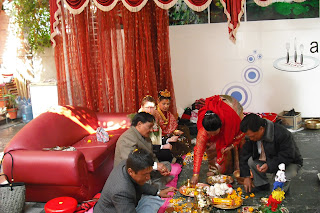 block or two without coming across a temple or other place for worship, at least in part because Buddhists’ homes are built around courtyards featuring these religious shrines. This was my first visit to Asia and actually my first visit to a non-Christian country, and I was surprised at how very different it felt to anyplace I’ve ever been before—from stupa (religious pillars) to prayer wheels (cylinders lined up around temples
 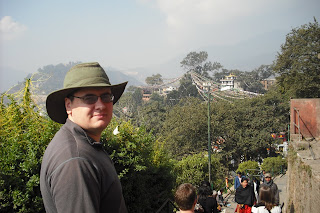 that you spin) to statues of Buddha and Hindu prophets. Similarly new and exciting was witnessing a Newari (one of the tribes within Nepal) wedding. The wedding was actually 3 different events (and would have been many more if the groom were also Nepali). The first was the wedding ceremony in which the bride’s father and a priest were the primary actors.
 After they prayed together, the bride and groom joined them and offered similar prayers. The next event was the reception attended by the bride’s family and friends. Much like American weddings, there was lots of food and music, and the primary actor was the bride who sat on a couch where she was greeted by guests as they entered. The final event (held the following night)
 was at the bride’s parents’ home where the family formally welcomed the groom into the family. This evening was all about food, with 30+ dishes (traditionally, 84) being served to the groom and his guests.
Nepal is a very friendly place. Not only were our hosts incredibly gracious (we got no less than 3 welcome scarves—similar idea to a lei), but as the French lady behind us in the immigration line noted, “there is a certain zen” to Nepal. Throughout our whole stay, we were really treated like guests of honor, though that treatment should have been reserved for the groom and his family. We were given front row seats at the wedding ceremony and given guided tours of Kathmandu’s highlights by the bride, her uncle, and her sister.
Nepal is steeped in religion and ritual. The west part of Nepal is the birthplace of Buddhism, and it’s impossible to go more than a
 block or two without coming across a temple or other place for worship, at least in part because Buddhists’ homes are built around courtyards featuring these religious shrines. This was my first visit to Asia and actually my first visit to a non-Christian country, and I was surprised at how very different it felt to anyplace I’ve ever been before—from stupa (religious pillars) to prayer wheels (cylinders lined up around temples
  that you spin) to statues of Buddha and Hindu prophets. Similarly new and exciting was witnessing a Newari (one of the tribes within Nepal) wedding. The wedding was actually 3 different events (and would have been many more if the groom were also Nepali). The first was the wedding ceremony in which the bride’s father and a priest were the primary actors.
 After they prayed together, the bride and groom joined them and offered similar prayers. The next event was the reception attended by the bride’s family and friends. Much like American weddings, there was lots of food and music, and the primary actor was the bride who sat on a couch where she was greeted by guests as they entered. The final event (held the following night)
 was at the bride’s parents’ home where the family formally welcomed the groom into the family. This evening was all about food, with 30+ dishes (traditionally, 84) being served to the groom and his guests.
 [Pictures: 1) wedding ceremony, 2) Francis at the Monkey Temple, 3) Sarah in Durbar Square, 4) One of many Monkeys at the Monkey Temple]
Nepal is absolutely beautiful. The bulk of our time was spent in the Kathmandu Valley which would definitely be classified as urban. Given that Nepal is a developing country, I was pleasantly surprised to find a city full of mostly permanent structures (i.e. not mud and grass). I was even more surprised to find some of the most intricate wood-carving (on windows, doors, and eaves) that I have ever seen. Nepal, though, isn’t known for Kathmandu, but rather for the Himalayan Mountains that make up the bulk of the country’s land area. Because of early-winter fog/haze and a ring of large foothills that circle Kathmandu, we couldn’t actually see the mountains from the city. We did, however, take a mountain flight, and as soon as our tiny 16-seat plane broke through the clouds, white-capped mountains extended as far as the eye could see. Having never really seen big mountains before, it’s  still difficult for me to fathom how big these mountains are, and it’s not like there are houses or even trees to provide some sense of scale. Most of the big peaks are 24,000-26,000 feet (Mt. Everest is 28,000 feet), compared to the Rocky Mountains’ 14,000-15,000 feet. [Everest is the peak in the middle of the picture] I think I need so do some hiking around them (or at least standing at the feet of them) to really get it. What I could fathom and found just as beautiful as the mammoth mountains were the inhabited foothills. The only way to make agriculture viable on such terrain is through terraced agriculture, and from the sky, these “steps” look like a real-life topographic map. I need to go back to Nepal when there are clearer skies so I can get a better picture, but even thinking about the image in my mind makes me smile.
In more ways than one, Nepal was a lovely break from Sudan. I was so happy to be in a place that required wearing a sweater (though in the mid-day sun, I was happy I had layered!), and Francis was thrilled to eat all sorts of spicy food. On a couple, occasions, though, Nepal felt a bit like our new home. While we were touring the Golden Temple in Patan, a little girl squatted right in the middle of the courtyard and proceeded to go to the bathroom, so much like the children of Kapoeta pooping on the side of the road. It also didn’t faze me when the power would go out for hours at a time—Nepal is dependent upon hydropower, and outside of monsoon season, they have rolling blackouts.
All in all it was a lovely trip, and I look forward to going back someday soon (it’s certainly not handicapped accessible, so it’s not something to leave to old age!).
 still difficult for me to fathom how big these mountains are, and it’s not like there are houses or even trees to provide some sense of scale. Most of the big peaks are 24,000-26,000 feet (Mt. Everest is 28,000 feet), compared to the Rocky Mountains’ 14,000-15,000 feet. [Everest is the peak in the middle of the picture] I think I need so do some hiking around them (or at least standing at the feet of them) to really get it. What I could fathom and found just as beautiful as the mammoth mountains were the inhabited foothills. The only way to make agriculture viable on such terrain is through terraced agriculture, and from the sky, these “steps” look like a real-life topographic map. I need to go back to Nepal when there are clearer skies so I can get a better picture, but even thinking about the image in my mind makes me smile.
In more ways than one, Nepal was a lovely break from Sudan. I was so happy to be in a place that required wearing a sweater (though in the mid-day sun, I was happy I had layered!), and Francis was thrilled to eat all sorts of spicy food. On a couple, occasions, though, Nepal felt a bit like our new home. While we were touring the Golden Temple in Patan, a little girl squatted right in the middle of the courtyard and proceeded to go to the bathroom, so much like the children of Kapoeta pooping on the side of the road. It also didn’t faze me when the power would go out for hours at a time—Nepal is dependent upon hydropower, and outside of monsoon season, they have rolling blackouts.
All in all it was a lovely trip, and I look forward to going back someday soon (it’s certainly not handicapped accessible, so it’s not something to leave to old age!).
A Heroic Journey from Kapoeta to Kathmandu
I have received more than a couple concerned emails wondering about the lack of posts for the past two weeks. As I mentioned in my Thanksgiving post, for the week of Thanksgiving, we had little to no internet connection. Then, the day after Thanksgiving, we began what can only be described as a heroic journey to attend the wedding of a friend in Nepal.
I’ve alluded to this Nepal trip previously, but had been purposely vague with details because, to be honest, our travel plans really weren’t set until we actually got on the road. The reason: we were waiting for the Indian Consulate in Juba to issue our transit visas and return our passports so that we could leave Sudan to begin our journey. We had hoped that the Indian visas would be issued earlier Thanksgiving week so that they could be couriered to us by Francis’ colleague on his way back to Kapoeta. When he showed up on Thanksgiving, though, without our passports in hand, the only option for us was to hop in the truck and drive to Juba (waiting for the next plane would have made us 2 days late for the wedding).
As I’ve mentioned before, the condition of the roads in Southern Sudan is indescribable. In the absence of any radio stations to entertain us throughout our journey, I instead compiled the following statistics in hopes of trying to illustrate what we experienced:
Distance traveled: 290 km (180 miles)
Elapsed time: 9 hours
Average speed: 32 kph or 20 mph (about 15 mph faster than possible during rainy season or probably wise)
River crossings: 38 (about half of these were on wooden bridges. For the rest, the road led directly across the riverbed. Thankfully, it’s a dry season and so 4WD was only required twice.)
Herds of beasts blocking our travel path: 11 (roughly equal numbers of goats and steers)
Armored tanks rusting on the side of the road: 3 (likely many more were present, but camouflaged in the weeds)
Monkeys!: 10 (some are probably better described as baboons)
Times my head hit truck ceiling: 5 (even though I was wearing my seatbelt)
For people planning to take this journey in the future, a couple helpful tips to make your journey more comfortable:
1. Drivers and passengers alike my wish to consider drinking before taking the journey to relax your muscles. Careful, though; there are no flush toilets along the way.
2. While a motorcycle helmet would be overkill (and hot!) a Green Bay Cheese Head or similarly padded cap is recommended.
3. Ladies, do yourselves a favor and wear a sports bra.
So, at the end of the 9-hour Leg 1, we arrived in Juba on Friday night. By the time we arrived, I was so exhausted that I had completely forgotten that I was SERIOUSLY craving ice cream after 3 weeks without, and instead passed out at a Juba hotel (I woke up with some sort of rash all over my left arm which can’t be directly linked to the hotel, but we can’t come up with any other explanation than some sort of bed bug—yuck!). Since our visas had thankfully been issued on Friday, we were able to continue on our journey on Saturday. Leg 2 involved taking a normal-sized airplane to Nairobi, where we checked into what looked to me like one of the world’s most beautiful hotels. Now, since I’ve been roughing it in Sudan for over a month, it is very possible that even a Days Inn in Peoria would look luxurious (hot water! Air conditioning! A padded desk chair!). However, the Fairview Hotel in Nairobi really is a beautiful place with pretty gardens, lots of wood paneling, and five restaurants including a wine bar, pizza kitchen, and ice cream parlor! We spent most of Saturday and Sunday basking in the glories of a place without dust, eating all of the fresh veggies and dairy that was so lacking in Sudan, and catching up on work (Francis) and preparing a couple job applications (me).
On Sunday afternoon we headed for the Nairobi airport for the final 3 legs of our journey that would take us through 4 national capitols in 24 hours. Leg 3 was a flight from Nairobi to Addis Ababa (Ethiopia). The hub for Ethiopian Air was actually much nicer than I expected, with a terminal that couldn’t be more than 10 years old. The real surprise was that there were no periodicals (magazines/newspapers) available ANYWHERE in the airport—even the Juba airport sells newspapers! Leg 4 was an overnight flight (6 hrs) from Addis to Delhi (India). It was a good thing that we got the transit visas because it bought us a stay in the main terminal rather than Indian Purgatory, the transit lounge where we were trapped on our return trip. I think this is the appropriate place to insert that, though I am generally eager to travel to almost anyplace (hello—I live in Sudan!), this trip has completely turned me off to India. Not only did we have troubles getting (expensive and ridiculous) transit visas and suffer the isolation of purgatory, the Delhi airport also has a ridiculous baggage screening process (the baggage screeners didn’t put a tag on my purse which I learned was necessary right before we boarded the plane, so I had to return to the xray machines and go through a full-body pat down all over again). Additionally, the airport has the loudest and most obnoxious announcements (a final boarding call for each flight was given about 15 times) , especially when heard at 2am. Alright, back to the journey. The final and 5th Leg was from Delhi to Kathmandu (Nepal). There is so much to tell of Nepal, that it deserves its own post.
Random take-aways from the journey:
1. Nairobi is a great introduction to Africa or “Africa-Lite”; international standard creature comforts, mostly English-speaking, beautifully green.
2. Logic puzzles must be an American thing. I had complete the GAMES puzzle magazine that Francis found for me (and completely got hooked on the “paint by numbers” puzzles), and have looked everywhere for another, but to no avail. Books of crossword puzzles or Sudoku are available, but no logic puzzles. Sadness.
3. India sucks.
Monday, November 30, 2009
Thanksgiving in Sudan
I’ll be honest, I woke up Thanksgiving morning in a not-so-great mood. I’ve always had a hard time coping with being away from family on a holiday, but this time I felt particularly isolated since both of our ways to access internet had been down for the past 2 days. However, Francis’ attempts to cheer me and some reflection on the meaning of Thanksgiving helped reveal much to be thankful for. There obviously are many other things that I’m thankful for—family, friends, health, and limitless opportunities—but these are just some of the highlights specific to 2009.
Thank you for… a delicious feast with great people. Despite the nearest grocery store being 8+hrs away, the owners of the safari camp where we’re staying managed to pull together all of the fixings for a real American-style Thanksgiving feast: turkey, stuffing, gravy, potatoes, green beans and carrots, yummy butternut squash (made like mashed potatoes with garlic). When we first arrived in Africa (2 months ago!) I had imagined a feast like this, and bought the requisite ingredients (including a $17 box of Stovetop) while we were in Kampala. Since our stuff is still awaiting clearance, however, I had written a true Thanksgiving feast off as an unattainable dream. But to be presented with an excellent (and mostly traditional) meal, I was moved to tears. …and the most exciting part was that I wasn’t the only one excited about the food. There were 9 of us at the feast, and even for the 4 people who were experiencing their first Thanksgiving dinner, the idea of gathering around a big table and celebrating the full bounties of a harvest (rather than just rice and beans) was something appreciated by all. I think I have a much better appreciation now for how the pilgrims must have felt.
Thank you for… an opportunity to be back in the kitchen. Francis and I wanted to contribute in some way to the meal, and so were responsible for dessert. Given the limited availability of anything but the very basics (sugar, flour, butter), we opted to use walnuts and powdered sugar we had purchased in Juba (on a whim—thank you, Lord!) to make Mexican Wedding Cookies. Francis’ tools came to the rescue when we realized that the oven was calibrated using gas marks, not temperature, so he pulled out his multimeter and thermocouple to find the gas mark roughly equal to 350F. Against all odds, the cookies turned out pretty good (people even requested permission to take leftovers home). Despite being without a stove for 2 months, I have not forgotten how fun it is to be in the kitchen especially with such an able co-chef; I even have a soft-spot for doing the dishes afterward.
Thank you for…a growing family. Calm down, Mom; there’S no bun in the oven. However, the Mills family now includes a four-legged friend—Morty, or, more formally, Mortise the Tortoise. Since we arrived, the locals have been wondering when we’d get a goat, and the expats have been trying to pawn off dogs on us. We’ve even had someone offer to sell us a monkey (very sad). Francis and I aren’t really pet people, but on a whim I told one of his workers that I might be able to tolerate something like a turtle. Well, lo and behold, two days later, Stephen had managed to find someone who had a bed-pillow-sized leopard tortoise to sell us. Though tortoises are pretty common in our part of Sudan, they rarely get this big, often ending up on someone’s dinner plate when they are palm-sized. Not being a tortoise expert, I really don’t have any idea how old Morty is, but he’s certainly seen his fair share of the world. As you might expect, he’s been a little shy, but he’s gradually coming out of his shell, now feeling comfortable enough to keep his eyes on us, rather than completely hiding. After some internet research, I’ve learned that leopard tortoises like grass and aloes (neither of which are terribly abundant yet on our compound), and so we’ve been supplementing his grazing diet with cabbage leaves. I also give him a big dish of water each day which he’s gradually realizing is safe to drink. While we’re gone in Sudan, I’ve arranged to have my gardener care for him, promising him a bonus when I return if both the garden and tortoise are healthy and happy. I think he thinks I’m a little crazy…
PS. A very random note, but I always forget to mention: Dad, you’d love East Africa—they have toothpicks on every table and even serve them to you as part of your cutlery packet on airplanes!
Thank you for… a delicious feast with great people. Despite the nearest grocery store being 8+hrs away, the owners of the safari camp where we’re staying managed to pull together all of the fixings for a real American-style Thanksgiving feast: turkey, stuffing, gravy, potatoes, green beans and carrots, yummy butternut squash (made like mashed potatoes with garlic). When we first arrived in Africa (2 months ago!) I had imagined a feast like this, and bought the requisite ingredients (including a $17 box of Stovetop) while we were in Kampala. Since our stuff is still awaiting clearance, however, I had written a true Thanksgiving feast off as an unattainable dream. But to be presented with an excellent (and mostly traditional) meal, I was moved to tears. …and the most exciting part was that I wasn’t the only one excited about the food. There were 9 of us at the feast, and even for the 4 people who were experiencing their first Thanksgiving dinner, the idea of gathering around a big table and celebrating the full bounties of a harvest (rather than just rice and beans) was something appreciated by all. I think I have a much better appreciation now for how the pilgrims must have felt.
Thank you for… an opportunity to be back in the kitchen. Francis and I wanted to contribute in some way to the meal, and so were responsible for dessert. Given the limited availability of anything but the very basics (sugar, flour, butter), we opted to use walnuts and powdered sugar we had purchased in Juba (on a whim—thank you, Lord!) to make Mexican Wedding Cookies. Francis’ tools came to the rescue when we realized that the oven was calibrated using gas marks, not temperature, so he pulled out his multimeter and thermocouple to find the gas mark roughly equal to 350F. Against all odds, the cookies turned out pretty good (people even requested permission to take leftovers home). Despite being without a stove for 2 months, I have not forgotten how fun it is to be in the kitchen especially with such an able co-chef; I even have a soft-spot for doing the dishes afterward.
Thank you for…a growing family. Calm down, Mom; there’S no bun in the oven. However, the Mills family now includes a four-legged friend—Morty, or, more formally, Mortise the Tortoise.
 Since we arrived, the locals have been wondering when we’d get a goat, and the expats have been trying to pawn off dogs on us. We’ve even had someone offer to sell us a monkey (very sad). Francis and I aren’t really pet people, but on a whim I told one of his workers that I might be able to tolerate something like a turtle. Well, lo and behold, two days later, Stephen had managed to find someone who had a bed-pillow-sized leopard tortoise to sell us. Though tortoises are pretty common in our part of Sudan, they rarely get this big, often ending up on someone’s dinner plate when they are palm-sized. Not being a tortoise expert, I really don’t have any idea how old Morty is, but he’s certainly seen his fair share of the world. As you might expect, he’s been a little shy, but he’s gradually coming out of his shell, now feeling comfortable enough to keep his eyes on us, rather than completely hiding. After some internet research, I’ve learned that leopard tortoises like grass and aloes (neither of which are terribly abundant yet on our compound), and so we’ve been supplementing his grazing diet with cabbage leaves. I also give him a big dish of water each day which he’s gradually realizing is safe to drink. While we’re gone in Sudan, I’ve arranged to have my gardener care for him, promising him a bonus when I return if both the garden and tortoise are healthy and happy. I think he thinks I’m a little crazy…
PS. A very random note, but I always forget to mention: Dad, you’d love East Africa—they have toothpicks on every table and even serve them to you as part of your cutlery packet on airplanes!
Subscribe to:
Posts (Atom)